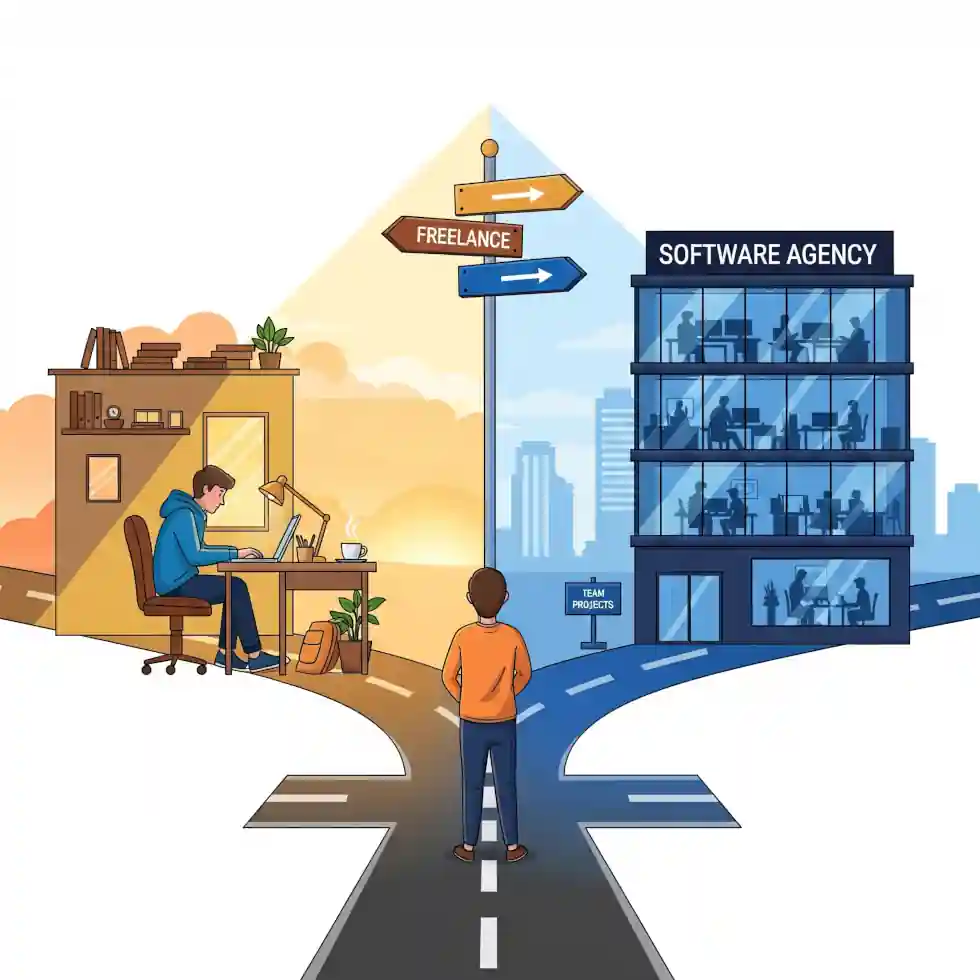
You are facing a key decision: you need to develop software, an application or a web platform, and you can't decide whether to approach an independent freelancer or give the project to a whole software agency. Both paths can lead to a successful result, but each has its specifics, advantages and pitfalls. The right choice depends mainly on the nature of your project, your budget, the time frame and how willing you are to take part in the project.
Let's take a detailed look at what each option offers.
An independent developer (freelancer)
A freelancer is an independent professional who offers their skills on a project basis. It can be a programmer or a coder, but also a UX/UI designer or a tester.
Advantages of a freelancer:
- Lower price: Freelancers usually have lower overheads (they don't need offices, project managers or HR departments), which is often reflected in a lower hourly rate or total project price.
- Direct and fast communication: You communicate directly with the person working on your project. There is no project manager in between, which can lead to faster problem solving and more flexible responses to changes.
- High specialization: Many freelancers specialize narrowly in a specific technology, language or type of project (for example iOS mobile applications in Swift). If you are looking for a top expert in one specific area, a freelancer can be the ideal choice.
- Flexibility: Independent professionals are often more willing to adapt to your processes and timing.
Disadvantages of a freelancer:
- Limited capacity and range of skills: One person can only handle a limited amount of work. A complex project requiring front-end, back-end, design, testing and server administration is too big a bite for an individual. You will either have to lower your demands or put together and manage a team of several freelancers yourself.
- Risk of unavailability (the "bus factor"): What happens if your key freelancer falls ill, goes on holiday or decides to quit the project? Your project can come to a complete stop. Nobody can stand in.
- Lower scalability: If you suddenly need to speed up or expand the project, one person can hardly inflate their capacity.
- Need for your supervision: Working with a freelancer often requires you to be more actively involved in managing the project, especially if you hire several specialists at once.
When to choose a freelancer?
For smaller, clearly defined projects such as a simple website, an application prototype, a specific module, or when you need expert help with one particular technology. It is also ideal if you have a limited budget and, at the same time, enough time and experience to manage the project at least partly yourself.
A software agency
An agency is a company that brings a team of specialists together under one roof – from project managers, analysts and UX/UI designers, through front-end and back-end developers, to testers (QA) and DevOps engineers.
Advantages of an agency:
- A complete team in one place: You get access to the whole range of skills. An agency can cover the entire software development life cycle, from the initial analysis to deployment and long-term maintenance.
- Substitutability and reliability: If someone on the team falls ill or leaves, the agency has internal resources to replace them, so your project continues smoothly.
- Proven processes and management: Agencies have established procedures for project management (often agile methods such as Scrum), quality control and communication. This brings order and predictability to the project.
- Scalability and speed: Need to speed up? The agency can put more people on the project. Need a new feature? The team can easily add the right specialist.
- Guarantees and responsibility: A contract with an agency usually provides more legal certainty, warranties for the work done and clearly defined responsibility for the result.
Disadvantages of an agency:
- Higher price: All the advantages above – the team, the background, management, certainty – are reflected in a higher price. Agencies have significantly higher overheads than individuals.
- Less flexibility and more bureaucracy: Communication often goes through a project manager, and changes to the assignment have to go through a more formal process. Quick, ad-hoc changes can be more complicated.
- A less personal approach: You may be one of many clients. Even if a dedicated team takes care of you, the personal connection may not be the same as with a freelancer.
When to choose an agency?
For medium and large projects that require coordinating several specialists (design, development, testing). It is the ideal choice for complex systems, long-term projects with plans for further development, or when you have neither the time nor the experience to manage the project yourself and prefer a partner who takes full responsibility for delivery.
A clear comparison
| Criterion | Freelancer | Agency |
|---|---|---|
| Price | Lower | Higher |
| Range of services | Limited (specialized) | Complete (all in one) |
| Communication | Direct and informal | Managed (through a project manager) |
| Flexibility | High | Lower (set by processes) |
| Speed | Depends on one person's capacity | Higher (thanks to a bigger team) |
| Reliability | Lower (risk of dropout) | High (substitutability in the team) |
| Project management | Requires your involvement | Provided by the agency |
| Ideal for | Small, specific tasks, prototypes | Medium and large, complex projects |
How I work
Although I am a freelancer and this domain is my name, I work more like an agency. I have a team of very skilled colleagues with different specializations, and it is a pleasure to work with them. Together we can offer you services like an agency does. In particular:
- Much faster delivery of the final application
- All the specializations your project needs, such as a programmer, a tester, an architect, a graphic designer and a project manager.
- Substitutability and reliability
- Flexibility
Beware of work resellers
Development work is simply expensive and, in a way, scarce. That is fertile ground that motivates many people to trade this work like a commodity. The internet is full of agencies that simply take on an order and then resell it to some cheaper freelancer, while presenting themselves as a "software house". To my horror, I found that they make up almost 75% of such agencies on the Czech internet.
Why do they do it?
Simply for money. And not a little. Imagine that such an agency charges, say, €100 per hour + VAT and finds a contractor on a freelance marketplace whom it pays, say, €2 per hour. Its reward for an ad that cost a couple of euros is then in the tens of thousands. It remains to explain why a freelancer would work for €2 per hour. Simply put, they are a beginner with no sense of prices, which is typical for people entering IT. These resellers know this perfectly well and deliberately present the work in such a way that the unlucky beginner asks for really little.
Why should I avoid them?
Little added value
The contact to the contractor costs you tens of thousands, while you could find one yourself for next to nothing, with just a little searching on freelance marketplaces.
They guarantee nothing
Do you know why contract programmers have a confidentiality clause in their contract? It simply isn't meant for your eyes. If you read it and compared it with the contract the agency signed with you, you would find that the agency tries to shift all responsibility onto its suppliers – the programmers. It would then be perfectly clear to you that this business partner of yours does not intend to guarantee absolutely anything.
Low quality of work
Remember what I wrote a few sentences ago about why they do it? Their profit is the difference between income and expenses, so they will set you up with a beginner.
A game of Chinese whispers
If there is an intermediary between the customer and the programmer, you can be sure that information gets lost and everything is delayed. Definitely not something you need.
How do I recognize them?
Find out how many employees they have
You can find this out roughly in the public business register (in the Czech Republic, ARES). It may not be entirely conclusive: the register only shows a range, and you don't know whether all employees are really programmers. But if your business partner is in the 1-5 category and talks about the project in superlatives, you should be on your guard.
How many projects have they worked on?
You probably imagine that the more references someone has, the better and more experienced they are. WRONG. If someone is happy with a programmer, they ask them to continue on the project. Some projects can last three years or more. When I worked for someone, it was always for at least 18 months. Logically, then, a programmer can't have dozens of projects on their website and a long list of "references" from happy customers. On the contrary, some customers don't want the author to admit working for them, and the project shows only their logo. Reselling a project, on the other hand, takes a few days, so the "reseller" collects one order after another (and simply makes up the references).
Conclusion: there is no universal answer
The choice between a freelancer and an agency is not a choice between "good" and "bad". It is a strategic decision that has to match your specific needs.
- Do you have a small budget and a simple, clearly defined task? A freelancer is probably the more efficient choice.
- Are you planning a complex platform that will grow over the long term, and do you want to rely on professional management and guaranteed capacity? Investing in an agency will pay off.
Before the final decision, always check references carefully, go through the portfolios of completed projects and, above all, make sure you get along with the potential supplier on a human level – whether it is an individual or a team. Good communication and mutual trust are the foundation of every successful software project.